

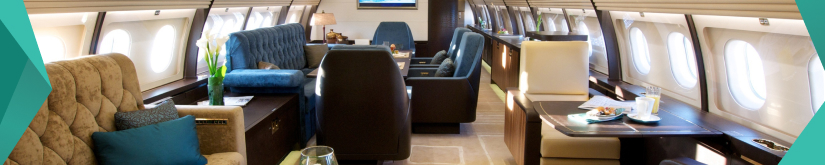
Business jet flights with pets: your dog or cat in the cabin
On a private jet your dog or cat stays in the cabin beside you from boarding to landing. There is no check-in desk for animals, no crate in the hold and no wait in a cargo shed after arrival: you walk through the business aviation terminal side by side and leave the aircraft together. For an animal that is anxious, old or simply too large for an airline cabin, this is often the only way to travel by air without being separated from its owner.
European Private Jets is a broker. We look for an operator that accepts your animal on board, choose an aircraft with enough floor space for it and check the animal's documents against the rules of the destination before you sign anything. The animal needs no ticket, because the price is for the whole aircraft: a light jet from Paris Le Bourget to London Biggin Hill costs from EUR 8,500 one way, with or without a dog on board.
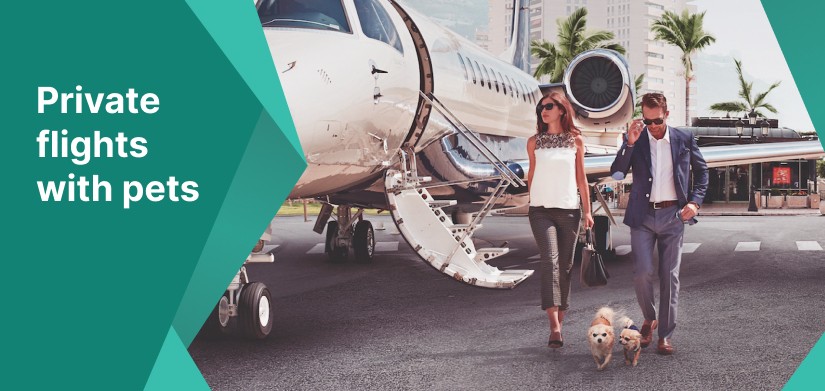
Send the route, the date, the passengers and a few words about your pet, and we will reply with offers from operators that accept it:
Prices for flights with a pet
The animal adds nothing to the charter price: you pay for the aircraft, the same with or without a dog on board. What the animal does influence is the choice of aircraft. A cat or a small dog fits any light jet, while a large dog is more comfortable on the flat floor of a Pilatus PC-24 or a midsize jet, and several big dogs travel best in a super midsize cabin.
Is there a surcharge for the animal?
No. The animal is not counted as a passenger, needs no ticket and pays no passenger tax. Three costs can still appear, and each one is stated in the offer before you sign:
No fare and no passenger tax. The price is for the whole aircraft, whatever the number of animals on board.
EUR 0The approved team that meets the aircraft scans the microchip and checks the papers. The handling agent charges a fee for this, shown in the offer.
Charged only if the seats or carpet are soiled or damaged, under the charter contract. A blanket for the seat and absorbent pads usually prevent it.
Some operators ask for a deposit, returned after the flight if the cabin is undamaged. The offer says whether it applies.
Popular routes by the size of the dog
One-way prices for the whole aircraft. A cat or a small dog travels in a Citation CJ3, a large dog on the flat floor of a Pilatus PC-24, and two or three big dogs in a Challenger 350.
More routes across Europe
The flight time is that of the light jet.
| Route | Light jetCitation CJ3 | Flat floorPilatus PC-24 | MidsizeCitation Latitude |
|---|---|---|---|
| Into Great Britain, airports approved for pets | |||
| Amsterdam - London Farnborough1:03 h | EUR 8,500 | EUR 10,500 | EUR 11,500 |
| Zurich - London Luton1:37 h | EUR 10,500 | EUR 12,500 | EUR 14,500 |
| Milan Linate - London Farnborough1:52 h | EUR 11,500 | EUR 13,000 | EUR 15,500 |
| Palma - London Farnborough2:21 h | EUR 13,000 | EUR 15,000 | EUR 17,500 |
| Ireland, Malta, Finland, Norway: tapeworm treatment for dogs | |||
| Paris Le Bourget - Dublin1:35 h | EUR 10,500 | EUR 12,500 | EUR 14,000 |
| Hamburg - Helsinki2:07 h | EUR 12,000 | EUR 14,000 | EUR 16,500 |
| Vienna - Malta2:25 h | EUR 13,000 | EUR 15,000 | EUR 18,000 |
| Milan Linate - Oslo2:47 h | EUR 14,000 | EUR 16,500 | EUR 19,500 |
| Holidays by the sea and in the Alps | |||
| Zurich - Palma1:53 h | EUR 11,500 | EUR 13,500 | EUR 15,500 |
| Copenhagen - Geneva2:05 h | EUR 12,000 | EUR 14,000 | EUR 16,500 |
| Vienna - Mykonos2:25 h | EUR 13,000 | EUR 15,000 | EUR 18,000 |
| Hamburg - Ibiza2:57 h | EUR 15,000 | EUR 17,000 | EUR 20,000 |
| Amsterdam - Faro3:14 h | EUR 15,500 | EUR 18,000 | EUR 22,000 |
| Between European cities | |||
| Paris Le Bourget - Zurich1:10 h | EUR 9,000 | EUR 11,000 | EUR 12,500 |
| Milan Linate - Vienna1:22 h | EUR 9,500 | EUR 11,500 | EUR 13,000 |
| Amsterdam - Copenhagen1:23 h | EUR 9,500 | EUR 11,500 | EUR 13,000 |
| Munich - Stockholm Bromma2:17 h | EUR 12,500 | EUR 14,500 | EUR 17,500 |
Handling, landing fees and passenger taxes are added in the quote. From Paris Le Bourget or Nice the French solidarity tax is about EUR 420 per jet passenger on these routes, and flights to or from Italy add EUR 100 per passenger up to 1,500 km and EUR 200 beyond. A return with the aircraft waiting is priced on request. More routes and hourly rates are on the private jet prices page.
A positioning flight costs 30-60% less than a normal charter, and a pet can travel on it if that operator accepts animals. For an arrival in Great Britain the operator must also be approved for the airport. See Empty Legs.
On a Jet Sharing flight the other passengers have to agree to an animal on board, so mention it before you book a seat.
Private jet or airline: what changes for the animal
Airlines set one policy for thousands of passengers. On a charter the operator decides for one flight, and the cabin belongs to your group, so a large dog, two cats or a parrot can usually come along once the operator has agreed.
| Question | Scheduled airline | Private jet |
|---|---|---|
| Where the animal travels | In the cabin only if small, in a bag under the seat; larger animals in the hold | In the cabin beside you, whatever its size, once the operator has approved it |
| Weight in the cabin | Usually up to 8 kg including the bag, on some airlines up to 10 kg | No fixed limit: the aircraft is chosen for the animal |
| Short-nosed breeds | Often refused in the hold | Travel in the cabin where you can watch their breathing |
| Number of animals | Often one per passenger and a few per flight | Several animals together, within the legal limits and the operator's rules |
| At the airport | Early check-in, the animal handed over and collected separately | Business aviation terminal: arrive about 30 minutes before departure and board together |
| Heat and cold | Transport in the hold may be suspended in hot or very cold weather | The animal stays in the heated or cooled passenger cabin |
| Arrival in Great Britain | Most pets arrive as cargo and are collected from an animal reception centre | The pet arrives in the cabin and is checked by an approved team at the private terminal |
What does not change are the entry rules. A private flight crosses the same borders as an airliner, so the microchip, the rabies vaccination and the travel document are checked in the same way. The difference is that one missing stamp affects one family, and we can see it on the copies days before the flight.
Dogs on board: size, weight and the right aircraft
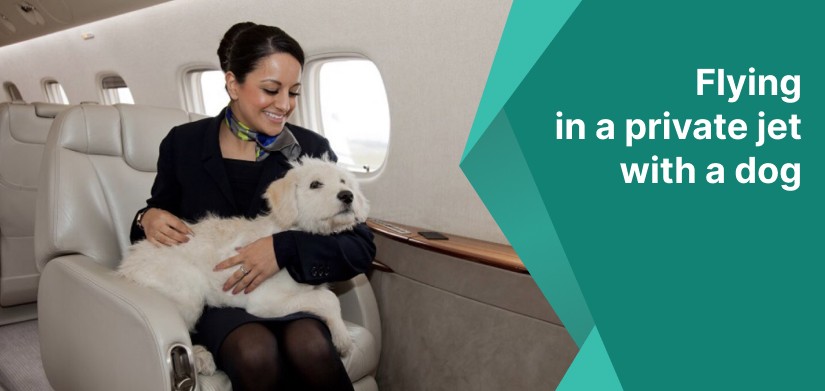
For a dog three things matter: its weight, the floor space it needs lying down and how it copes with the aircraft steps. The cards show how dogs usually travel and which class suits them. The final word belongs to the operator, which may limit the weight or the number of animals on a particular aircraft.
In a carrier or on your lap during the cruise; in the carrier or on a harness for take-off and landing.
Aircraft: any class, including turboprops and very light jets.
On the floor or on a covered seat, harness clipped to a seat belt.
Aircraft: light jets such as the Citation CJ3; some very light jet operators take only one dog of this size.
Lying on the floor between facing seats, wearing a harness.
Aircraft: light jets with a flat floor such as the Pilatus PC-24, or midsize jets.
Lying in the aisle or an open area of the cabin; needs help on the steps.
Aircraft: midsize jets such as the Citation Latitude, super midsize jets such as the Challenger 350 and larger.
- The steps. Most light jets have a narrow door and steep airstairs. An old or heavy dog may need to be lifted or helped, so tell us in advance and the crew will be ready for it.
- A flat floor. In many light jets the aisle is lower than the floor under the seats. The Pilatus PC-24, the Citation Latitude and the Challenger 350 have a flat floor, where a big dog can stretch out.
- Fewer passengers with a big dog. On very light jets some operators cap each animal at about 25 kg and reduce the number of passengers when a heavy dog is on board, because it takes up floor space and payload.
- Two or three dogs. Several dogs travel comfortably in a midsize cabin. Name every animal in the request, with its weight, so the operator approves the whole group at once.
Cats on board
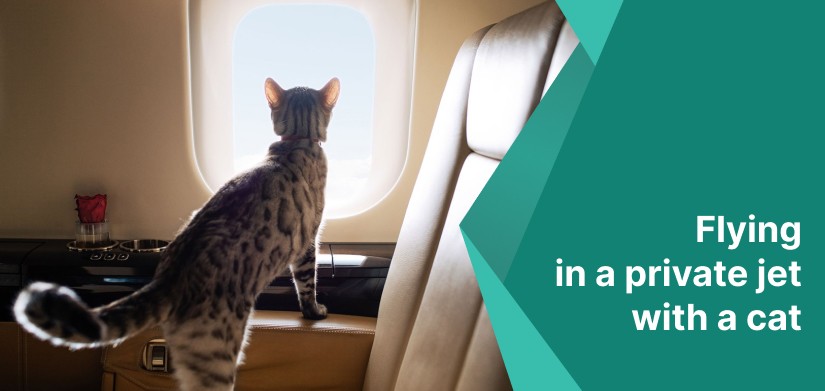
Most cats travel best in a carrier they know, placed on the seat next to you or at your feet. On a charter nobody asks you to push it under the seat in front.
- Choose a rigid, well-ventilated carrier in which the cat can stand up and turn round. Leave it open at home for a few weeks with a blanket that smells of the house.
- For take-off, landing and turbulence the cat stays in the carrier. During the cruise many crews allow a calm cat on your lap, on a harness.
- A litter tray is rarely needed on flights of up to two or three hours. For a longer flight, a small folding tray with a little litter can be used in the aircraft washroom.
- A pheromone spray in the carrier 15-20 minutes before the cat goes in helps many animals settle. Avoid strong perfumes in the cabin.
- Large breeds such as the Maine Coon need a carrier the size of a small dog crate. Hairless breeds feel the cold and are happier with a blanket.
Short-nosed dogs and cats
Pugs, French and English bulldogs, Shih Tzus, Boxers, Persian and Exotic cats breathe with more effort than other breeds and cope badly with heat and stress. Many airlines refuse them in the hold for this reason. In the cabin the risk is much lower, provided you follow a few rules:
- Ask your vet whether the animal is fit to fly, especially if it is overweight or has had breathing problems. Some operators ask for a fitness-to-fly letter for these breeds.
- Do not give sedatives unless the vet prescribes them after a trial at home: they slow breathing and lower blood pressure.
- Keep the animal cool. In summer we ask the crew to cool the cabin before boarding, and an early morning or evening departure helps.
- Keep the animal where you can see it. In the cabin you notice laboured breathing at once, which is impossible in a cargo hold.
Ferrets, birds, rabbits and reptiles
Charter flights also carry animals that airlines rarely accept in the cabin. Each case is agreed with the operator, and the paperwork depends on the species.
European rules treat them like dogs and cats: microchip, rabies vaccination and a pet passport. The tapeworm treatment is for dogs only. Ferrets travel in a closed carrier.
There is no European passport for them, so the national rules of the destination apply. A sturdy ventilated carrier, hay, water and a cool, quiet cabin are what they need on board.
A travel cage strapped to a seat and covered with a light cloth. Bird movements face extra animal health rules, tightened during bird flu outbreaks, and many parrots, such as the African grey, are protected species that travel with CITES documents.
A closed container at a steady temperature. Popular tortoises such as Hermann's tortoise are protected, and CITES permits can take weeks, so start long before the flight.
Horses do not fly in business jets: they travel in cargo aircraft fitted with stalls, with their own grooms. If a move includes a horse and the family pets, we arrange the jet for the family and the animals in the cabin.
In the cabin: how the flight goes
The operator sets the rules on board and the commander applies them. They differ little from one operator to another:
- Boarding. The animal comes through the terminal with you, on a lead or in its carrier, and boards at the same time. Keep a muzzle to hand: some crews and some countries ask for one in public areas.
- Take-off and landing. A dog lies on the floor or sits on a seat with its harness clipped to a seat belt; cats and small dogs stay in their carriers. The same applies in turbulence.
- Cruise. The dog can lie next to you but does not wander around the cabin or block the way to the exits.
- Seats and carpet. Bring a blanket for the seat and an absorbent pad. If the cabin is soiled or damaged, the operator can charge for cleaning or repairs under the charter contract.
- Pressure and noise. The cabin is pressurised to the equivalent of no more than about 2,400 m, as in an airliner, and is far quieter than a hold. Chewing a treat during the climb and descent helps the ears adjust.
- Water and toilet. Water is always available; food only on long flights. Most adult dogs manage several hours if they are walked just before boarding, and on long routes a refuelling stop can include a short walk where the airport allows it.
When to postpone the flight
- Very young animals. To travel abroad a puppy or kitten needs a rabies vaccination, which cannot be given before 12 weeks, followed by 21 days of waiting. In practice that means at least 15 weeks of age. A few European countries accept younger animals under special conditions, most do not.
- Late pregnancy and recent birth. Travel in the last weeks of pregnancy and the first weeks after giving birth is usually advised against; the vet decides.
- Illness or recent surgery. An animal that is weak, recovering or has heart or breathing problems flies only with the vet's approval.
- Old or overweight animals. They tolerate heat and stress less well. A check-up before the flight, a cool cabin and water at hand reduce the risk.

Documents for dogs, cats and ferrets in Europe
A private jet changes the journey, not the law: the animal needs the same documents as on a car trip or an airline flight.
Within the European Union four conditions apply to dogs, cats and ferrets travelling with their owner:
An ISO-standard microchip, implanted before the rabies vaccination. A vaccination given before the chip does not count.
Given at the age of 12 weeks or more. After the first vaccination you wait at least 21 days before travelling; boosters given on time need no waiting period; a late booster counts as a first vaccination again.
Issued by a vet to owners who live in the EU. It is valid for the animal's life as long as the rabies vaccination recorded in it is valid.
Up to five animals travel under the pet rules on one trip. More animals may travel only to a competition, show or sporting event, and only if they are over six months old; otherwise commercial rules apply.
If the animal flies with someone else, that person carries the owner's written authorisation with the travel document, and the owner must travel within five days before or after the animal. Switzerland, Norway, Iceland, Liechtenstein, Monaco, Andorra, San Marino and the Vatican also issue pet passports in the same format.
What each destination asks for
Rules change, and individual countries add their own. The table gives the usual requirements; before each flight we check them for your route and your animal.
| Destination | Documents | In addition | Start preparing |
|---|---|---|---|
| Most EU countries | EU pet passport, microchip, rabies vaccination | Local rules for some dog breeds | A month ahead if the vaccination is still to be done |
| Ireland, Northern Ireland, Malta, Finland, Norway | EU pet passport, microchip, rabies vaccination | Dogs: tapeworm treatment 24-120 hours before arrival | Vet appointment one to five days before the flight |
| Great Britain | EU pet passport or animal health certificate, microchip, rabies vaccination | Dogs: tapeworm treatment; approved airport and operator; four dog types and the XL Bully banned | A week ahead; documents sent to the arrival airport |
| Switzerland | EU or Swiss pet passport, microchip, rabies vaccination | Import of dogs with cropped ears or docked tails is prohibited | As for the EU |
| United States | Dogs: microchip, minimum age of six months, online CDC dog import form | Rabies documents depend on the country of departure; some states add their own rules | A few weeks ahead |
| United Arab Emirates | Import permit, microchip, vaccinations, health certificate | Several dog breeds banned; requirements depend on the country of departure | Several weeks ahead |
| Turkey and other countries outside the EU list | Health certificate and the documents required by the country | A rabies antibody test is needed to come back into the EU | Two to three months ahead |
Flying into Great Britain with a dog or cat
This is the destination where a private jet makes the biggest difference. On scheduled flights most pets enter Great Britain as cargo. On a chartered private aircraft the animal arrives in the cabin, provided four conditions are met:
- An approved route. The arrival airport must be one that the British authorities list for pets on charter flights. Around London these include Farnborough, Biggin Hill, Luton, Stansted and Oxford; not every London airport is on the list.
- An approved operator. The approval covers the operator together with the airport, so two aircraft parked side by side can have different permissions. We offer only operators approved for your arrival airport.
- Documents. An EU pet passport is accepted, as are passports from Switzerland, Norway and several other European countries; otherwise an animal health certificate. Dogs need the tapeworm treatment one to five days before arrival, unless they fly directly from Ireland, Northern Ireland, Malta, Finland or Norway.
- The check on arrival. An approved team meets the aircraft at the private terminal, scans the microchip and checks the papers, usually within minutes. The handling agent charges for this service, and the cost is shown in the offer. Copies of the documents are normally sent to the airport a day or two before the flight.
Breeds restricted in some countries
Breed lists differ from country to country and often cover crosses and dogs that simply look like a listed type. Several of them apply to visitors as well as residents.
Pit Bull Terrier, Japanese Tosa, Dogo Argentino, Fila Brasileiro and XL Bully types banned unless the dog holds a certificate of exemption.
13 types banned, including for tourists: among them Pit Bull Terrier, Tosa Inu, American Staffordshire Terrier, American Bulldog, Boerboel, Kangal and several shepherd breeds from Central Asia and the Caucasus.
Import of Pit Bull Terrier, American Staffordshire Terrier, Staffordshire Bull Terrier, Bull Terrier and their crosses is prohibited. Visitors staying no longer than four weeks are exempt with documents such as the pedigree and vaccination record; the federal states have further rules.
Entry of category 1 attack dogs, meaning Pit Bull, Boerboel and Tosa types without a recognised pedigree, is prohibited. Other listed breeds wear a muzzle and a lead in public.
Dogs with cropped ears or docked tails may not be imported; owners planning a short stay with such a dog should check the conditions with us before booking.
The aircraft operator may have its own policy for large guarding breeds, such as a muzzle in the terminal and on the apron. We clear the breed with both the destination and the operator before you receive an offer.
Outside Europe and the way back
For a trip beyond Europe, plan the return before the departure. The EU keeps a list of countries where rabies is under control. From listed countries, such as Great Britain, the United States or Canada, a pet returns with valid documents and no blood test. From countries that are not listed, Turkey among them, the animal re-enters the EU only with a rabies antibody test:
- the blood sample is taken at least 30 days after the rabies vaccination and analysed by an EU-approved laboratory;
- after a positive result, the animal waits three months from the date of the sample before entering the EU;
- if the test is done before leaving the EU and recorded in the passport, the three-month wait does not apply on return, provided the vaccinations are kept up to date.
Animals arriving from outside the EU enter through a designated travellers' point of entry, where documents and the microchip are checked. Not every airfield is one, so we choose the arrival airport with this in mind. Countries such as the United Arab Emirates also require an import permit issued before arrival, so that part of the paperwork starts first.
Preparation timeline
- 2-3 months beforeOnly for countries outside the EU list: microchip and rabies vaccination if missing, then the blood sample for the antibody test at least 30 days later.
- 1-2 months beforeMicrochip, rabies vaccination and pet passport if missing. Import permit for countries that require one; CITES papers for protected species.
- 21 days beforeLast day for a first rabies vaccination.
- 1-2 weeks beforeVet check-up. Send us copies of the passport pages, and we check them with the operator.
- 10 days beforeEarliest date for an animal health certificate, if you need one.
- 1-5 days beforeDogs flying to Great Britain, Ireland, Northern Ireland, Malta, Finland or Norway: tapeworm treatment, recorded by the vet with the date and time.
- 1-2 days beforeFor Great Britain: documents sent to the pet team at the arrival airport.
- Day of the flightOriginal documents, lead, harness, muzzle, carrier, a blanket for the seat, a folding bowl and water, absorbent pads and bags, usual medicines and the vet's phone number.
- A long walk before you leave home.
- A light last meal a few hours before departure.
- Water until boarding.
- After landing, water and a walk.
- The last meal four or five hours before the flight.
- Into the carrier calmly, in a closed room.
- After landing, water and a quiet room to explore first.
Booking a flight with a pet
- RequestRoute, date and passengers, plus the species, breed, weight and age of each animal, the size of the carrier and whether the animal has flown before.
- CheckWe ask operators for written consent for your animal and check the rules of the destination country and the arrival airport.
- OffersYou receive offers naming the aircraft, the operator and the price, with the conditions for the animal and any extra costs in writing.
- DocumentsYou send copies of the pet's papers; we check them with the operator and, for Great Britain, pass them to the arrival airport.
- Contract and flightThe animal is named in the contract. On the day you arrive at the terminal about 30 minutes before departure, or about an hour before for a flight leaving the Schengen area, with the original documents.
Payment by bank transfer, card or cryptocurrency is described on the payment page; cancellation charges follow the contract and our terms and conditions. Responsibility for the animal's documents stays with the owner, which is why we check them with you before confirming the flight.
Not sure whether your animal can fly on your route? Leave your number, and a manager will call you back:
Questions about flying with pets
-
- My dog weighs 40 kg: which aircraft do we need?
-
A light jet with a flat floor, such as the Pilatus PC-24, or a midsize jet such as the Citation Latitude, where the dog can lie between the seats. From Paris Le Bourget to London Biggin Hill they cost EUR 10,000 and EUR 11,000 one way respectively. Very light jets often limit the weight of each animal.
-
- Is an EU pet passport enough to fly into Great Britain?
-
Yes, if it was issued in an EU country, Switzerland, Norway or another country that issues the same passport, and shows a valid microchip and rabies vaccination. Dogs also need the tapeworm treatment one to five days before arrival, and the airport and operator must be approved for pets.
-
- Which London airports accept a pet arriving by private jet?
-
Farnborough, Biggin Hill, Luton, Stansted and Oxford are among the airports approved for pets on charter flights. The operator must hold the approval for that airport as well, so we confirm both before the contract.
-
- How old must a puppy or kitten be to fly abroad?
-
Usually at least 15 weeks: the rabies vaccination is given from 12 weeks of age and becomes valid 21 days later. A few European countries accept younger animals under special conditions. The United States admits dogs only from six months of age.
-
- Can I give my dog or cat a sedative before the flight?
-
Only if your vet prescribes it. Sedatives slow breathing and lower blood pressure, which is risky at altitude and especially for short-nosed breeds, and some operators refuse a sedated animal. A familiar blanket, a long walk and a treat to chew usually work better.
-
- Can a pug or a French bulldog fly on a private jet?
-
Yes, in the cabin beside you. Many airlines refuse short-nosed breeds in the hold, but in a cool cabin under your eyes the risk is much lower. A vet check before the flight is advisable, and some operators ask for a fitness-to-fly letter.
-
- How many animals can fly on one charter?
-
The pet rules allow up to five dogs, cats or ferrets on one trip; more are allowed only for competitions or shows, otherwise commercial rules apply. Within that limit the cabin size and the operator decide: two or three large dogs fit well in a midsize jet.
-
- Can my pet fly with a relative if I travel later?
-
Yes, with your written authorisation carried together with the pet's documents, provided you travel within five days before or after the animal. An animal travelling on its own is not covered by the pet rules.
-
- Can my dog travel on an Empty Leg?
-
Yes, if the operator of that flight accepts animals; the documents are the same. For an arrival in Great Britain the operator must also be approved for the arrival airport, which narrows the choice of legs.
-
- How far ahead should I book a flight with a pet?
-
Within Europe, with documents in order, two or three days are usually enough. For Great Britain allow about a week for the operator and airport approvals; for countries that need a permit or an antibody test, start two to three months ahead.
-
- What happens if a document is missing?
-
The operator can refuse boarding, and at the border the animal can be sent back or placed in quarantine at the owner's expense; in Great Britain quarantine can last up to four months. Sending us copies of the papers a week or two before the flight prevents this.
The aviation expert will answer all your questions about business aviation and private flights. We will help you to compare and choose the best business jet for your flight.