


Medical aviation flights: air ambulance and medical private jets
Medical aviation moves patients by air when the road is too long, a scheduled flight is impossible or the patient's condition needs care on board. Depending on what the doctors prescribe, the patient flies in a business jet with a nurse or doctor alongside, on a stretcher in a business jet with portable equipment, or in an air ambulance: an aircraft fitted as an intensive care unit, with a flight doctor and nurse on board.
European Private Jets is an air charter broker. We find the right aircraft through licensed operators, compare offers and link the flight to the people who look after the patient. Doctors, nurses and ground ambulances come from licensed medical partners: we name them in the offer and agree times, airport access and handovers with them. The aim is a bed-to-bed transfer, from the ward where the patient lies to the ward that receives them, with ground ambulances at both ends tied to the flight.
When a private medical flight makes sense
Almost every request we receive falls into one of these situations:
- Repatriation after illness or an accident abroad. A stroke on holiday in Spain, a fracture after a skiing fall in Austria, a heart attack during a business trip: once the patient is stable enough to travel, the flight brings them to a hospital near home.
- Transfer between hospitals in different countries. The family or the doctors choose a specialised centre, a private clinic or simply a hospital where relatives can visit every day.
- Planned treatment abroad. The trip to a European centre for surgery, proton therapy or rehabilitation, and the return when the stay is over.
- A call for a transplant. A patient on a waiting list far from the transplant centre has only a few hours after the call. Planning aircraft and airports in advance saves time on the day.
- Patients who cannot share a cabin with strangers. A weak immune system after chemotherapy or an infectious disease rules out a scheduled flight.
- when the drive takes less than two or three hours;
- the transfer to the airport, loading and the ambulance leg at the other end take time, so the aircraft rarely saves any.
- from about 400-500 km;
- for islands;
- when the patient tolerates long hours on the road badly;
- when an admission or an operating slot is fixed.
Not sure which option fits your case? Leave your number and a manager will call you back:
Business jet or air ambulance: the options
Not every patient needs an air ambulance, and not every patient can fly in an ordinary business jet. The treating doctor and the medical director of the provider decide on the level of care; our job is to find the aircraft that matches their decision.
| Option | For which patients | Who is on board | How it is priced |
|---|---|---|---|
| Scheduled flight with a medical escort | Stable patients who can sit for the whole flight, on routes with direct flights | A nurse or doctor next to the patient | Tickets plus the escort's fee |
| Business jet with a medical escort | Stable patients who sit or lie on the divan and need observation and simple treatment | Nurse or doctor, relatives | Price of the flight plus the escort |
| Business jet with a stretcher and portable equipment | Stable patients who must lie down for the whole flight, with oxygen and monitoring | Nurse or doctor, one or more relatives | Price of the flight plus stretcher, oxygen and team |
| Air ambulance | Patients who need intensive care: ventilation, continuous infusions, invasive monitoring | Flight doctor and intensive care nurse; one relative if there is room | One price for aircraft, team and equipment |
| Medical helicopter | Short transfers between hospitals or between a hospital and the airport | Doctor and nurse or paramedic | By model and flight time |
Who does what on a medical flight
Several parties work on one transfer, each with a clear responsibility. Knowing who answers for what avoids confusion at the worst possible moment.
Finds the aircraft and the operator, books the terminal and ground handling, matches the flight times with the medical team and the ambulances, and follows the trip until the handover.
Flies the aircraft under its Air Operator Certificate: crew, flight plan, slots, overflight and landing permits.
Reviews the medical file, sets the level of care, supplies the doctor, nurse, medicines and equipment, and is responsible for the care during transport.
Takes the patient from the ward to the aircraft and from the aircraft to the receiving ward, with a vehicle and staff that suit the patient's condition.
The first discharges the patient with a medical report; the second confirms the admission with a date and time.
For an air ambulance, aircraft and medical team usually come from the same operator, and we compare the offers available on the day. If the family has already chosen a medical provider, we work with that provider.
We do not give clinical opinions: whether the patient can fly, how and with what care is decided by the treating doctor and the provider's medical director.
On board an air ambulance
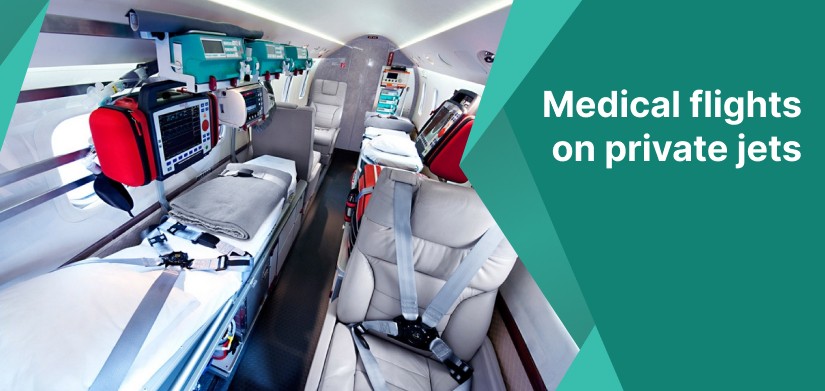
An air ambulance is a jet or turboprop in which some seats are replaced by one or two stretchers fixed to the floor, with transport versions of intensive care equipment. A typical set:
- Stretcher with a loading system. Locks into rails on the cabin floor; a ramp or lift brings the patient on board without lifting by hand. A vacuum mattress keeps an injured patient still.
- Transport ventilator. Supports or takes over breathing, for adults, children and newborns, and runs on battery during the ambulance legs.
- Monitor and defibrillator. Continuous ECG, blood pressure, oxygen saturation and exhaled carbon dioxide, with a shock delivered from the same unit if needed.
- Infusion pumps. Give medicines and fluids at a precisely controlled rate, as on a ward.
- Suction unit and blood gas analyser. Keep the airway clear and measure blood gases during the flight.
- Medical oxygen. A fixed supply sized for the flight time with a reserve for a diversion, plus portable cylinders for the transfers.
- Power supply. Dedicated sockets power the medical devices throughout the flight, so they do not depend on their batteries alone.
The medical team
- Flight doctor: usually an anaesthetist, intensive care or emergency physician with experience of air transport. The doctor takes over the patient on the ward and stays with them until the receiving bed.
- Intensive care nurse or flight paramedic: handles equipment, drugs and lines during the flight and both ambulance legs.
- Medical director: the provider's senior doctor reviews the file before the flight and decides on the team, the equipment and the conditions of transport.
- Pilots: agree the cruising level, cabin pressure and the rate of climb and descent with the medical team.
Special cases
Newborns travel in a transport incubator with its own ventilator and monitor; children need a paediatric team and equipment in the right sizes.
A transfer with extracorporeal circulation needs a specialised team and a wide cabin, and only a few operators in Europe carry it out.
The load limit of the stretcher and the width of the door narrow the choice of aircraft, so we need the patient's weight and height at the first call.
Some operators have isolation units with negative pressure, in which the patient travels separated from the team and the crew.
Cabin pressure, oxygen and flight altitude
At cruising altitude a jet's cabin is pressurised to the equivalent of up to about 2,400 m above sea level. For the body this is like breathing air with roughly 15% oxygen instead of 21%, and gas trapped in the body expands by about a third. A healthy passenger hardly notices; for some patients it matters.
Typical reasons are decompression sickness after diving, air left in the body after some operations on the eye, chest or brain, and severe lung disease. The decision is always the doctor's.
Aircraft used for medical flights
Medical flights in Europe rely on a handful of proven types, chosen for door width, cabin pressurisation, range and the runways they can use:
| Aircraft | Type | Where it fits |
|---|---|---|
| Learjet 45XR, Learjet 45, 35 and 60 | Light and midsize jets | Among the most common air ambulances on European routes: fast, with one intensive care patient or two stretchers, and usually a seat or two for companions. |
| Pilatus PC-12 and PC-24 | Turboprop and light jet | Both have a large cargo door and a flat floor that make stretcher loading easier, and both use short runways, including many island airports. |
| King Air 350 and King Air 200 | Twin turboprops | Used by many medical services in Europe for regional legs, at lower hourly costs and into airfields that jets cannot use. |
| Challenger 650, 604 and 605 | Heavy jets | Long range and a wide cabin: room for bulky equipment, two medical teams or several patients, and for relatives. Used to and from the Middle East, Africa and the Canary Islands. |
| Global Express | Long range jet | Intercontinental transfers without a stop; the cabin can take an intensive care place, a second stretcher and seats for companions. |
For several patients at once, some operators fly regional airliners converted for medical use. A stable patient who needs no intensive care flies in an ordinary business jet chosen for its cabin and door.
Medical helicopters
The helicopter covers short distances and places without a runway: between two hospitals, or from a hospital helipad to the airport where the jet waits. Beyond about 250-300 km an aircraft is usually faster, and its pressurised cabin is more comfortable for the patient. Private medical transfers use twin-engine types such as the Airbus H135 and H145 and the Leonardo AW109 and AW169.
Airports, night flights and the ambulance at the aircraft
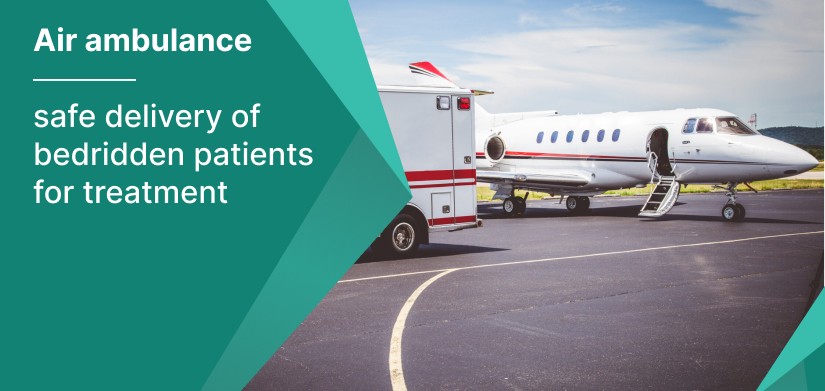
Medical flights use business aviation terminals. Where the airport allows it, the ground ambulance drives onto the apron with an escort from the handling agent and stops beside the aircraft, so the patient is moved from one stretcher to the other without passing through a terminal. The request for apron access goes in together with the terminal booking.
- Choice of airport. We pick the airport by the distance to the hospital rather than by its size. A smaller airfield close to the clinic often saves more time than the flight itself.
- Night flights. Many airports restrict night movements because of noise, and many of them make exceptions for medical and emergency flights. Each airport sets its own rules, so we check them before confirming the time.
- Flight status. In the flight plan, a medical flight is marked HOSP. A flight carrying a patient in a life-critical condition is filed as MEDEVAC and is exempt from air traffic flow restrictions in Europe.
- Borders. Inside the Schengen area there is no border check. On flights to and from the UK and other countries, passport and customs checks are arranged at the aircraft wherever the airport allows it.
European treatment centres and nearby airports
Some of the centres that receive patients from other countries, with the airports used for private flights:
Heidelberg Ion-Beam Therapy Centre at the university hospital
Mannheim City or FrankfurtWest German Proton Therapy Centre
DüsseldorfCharité university hospital
Berlin BrandenburgUniversity Hospital Zurich; proton therapy at the Paul Scherrer Institute
ZurichMedAustron, proton and carbon ion therapy
ViennaGustave Roussy cancer institute; Necker children's hospital
Paris Le BourgetGreat Ormond Street children's hospital; Royal Marsden; Royal Brompton
London Biggin Hill Farnborough LutonKarolinska University Hospital
Stockholm Bromma or Arlanda
Documents and fitness to fly
The medical provider cannot accept a patient without a recent medical file, and the flight cannot be confirmed without a bed at the other end. Please prepare:
- A current medical report: diagnosis, ongoing treatment, recent test results and vital signs, signed by the treating doctor, preferably in English.
- Fitness to fly: the treating doctor's assessment, which the provider's medical director confirms or completes.
- Confirmation from the receiving hospital: the ward, the doctor in charge and the time the patient is expected.
- Identity documents of the patient and companions, with visas where needed; for the UK, passports and, for most foreign visitors, an electronic travel authorisation (ETA).
- Consent of the patient or, if the patient cannot sign, of the legal representative; for a minor, of the parents.
- The insurer's written approval if a policy pays for the flight.
- A list of the medicines on board. Controlled drugs, such as strong painkillers, need documents confirming their medical use, and some countries require a permit.
How long it takes to organise
Who pays: insurance, health systems and families
The answer depends on where the patient is, why they are moved and who takes the decision. These are the general rules; for a particular case, check the policy wording or ask your health insurer.
Call the insurer's assistance centre before arranging any transport: the centre chooses the means of transport, and a flight booked without its approval is often not refunded. Some policies cover an air ambulance only from Europe and the Mediterranean.
The EHIC covers necessary treatment in public healthcare during a temporary stay in another EU country, Iceland, Liechtenstein, Norway or Switzerland. It does not cover repatriation.
With prior authorisation on the S2 form, the treatment is covered by the patient's health system; travel costs depend on national rules and are often not included.
When the patient or relatives decide on the move without a medical need, they pay for it themselves.
We can send the quote to the insurer and work with its case manager, and we prepare the documents an insurer usually asks for when it reviews a claim. Whether the cost is refunded is the payer's decision.

Medical flight prices
The cost has two parts: the flight and the medical care. For a business jet, the flight price below is for the whole aircraft, one way, and includes crew and fuel; handling, airport fees and passenger taxes are added in the quote. The figures apply when a suitable aircraft is near the departure airport. Stretcher, oxygen, medical team and ground ambulances are added according to the patient's needs.
Transfers and repatriation within Europe
| Routeflight time by PC-24 | TurbopropPilatus PC-12 | Light jetPilatus PC-24 | Midsize jetLearjet 75 |
|---|---|---|---|
| Milan Linate - Munich1:01 h | EUR 7,500 | EUR 10,500 | EUR 10,500 |
| Nice - Zurich1:06 h | EUR 7,500 | EUR 10,500 | EUR 11,000 |
| Split - Vienna1:12 h | EUR 8,000 | EUR 11,000 | EUR 11,500 |
| London Farnborough - Zurich1:36 h | EUR 9,000 | EUR 12,500 | EUR 13,000 |
| Rome Ciampino - Frankfurt1:51 h | EUR 9,500 | EUR 13,000 | EUR 14,000 |
| Madrid - Geneva1:54 h | EUR 10,000 | EUR 13,500 | EUR 14,000 |
| Palma - London Farnborough2:21 h | EUR 11,000 | EUR 15,000 | EUR 16,000 |
| Faro - Paris Le Bourget2:41 h | EUR 12,000 | EUR 16,000 | EUR 17,500 |
| Heraklion - Vienna2:42 h | EUR 12,500 | EUR 16,000 | EUR 17,500 |
| Ibiza - Hamburg2:57 h | EUR 13,000 | EUR 17,000 | EUR 18,500 |
| Antalya - Munich3:17 h | EUR 14,000 | EUR 18,000 | EUR 19,500 |
| Málaga - Hamburg3:33 h | EUR 14,500 | EUR 19,000 | EUR 21,000 |
The PC-12 is the least expensive option, but as a turboprop it is slower than a jet: Málaga to Hamburg takes close to five hours, against 3:33 h in a PC-24. On legs longer than two or three hours, that difference matters for a patient.
Longer routes to Europe
A fuel stop adds time on the ground for the patient as well as in the air, so on long routes the medical team often asks for a heavy jet that flies non-stop. Prices for other routes and aircraft classes are on the prices page.
Medical care
Intensive care, emergency medicine, cardiology, neurology or paediatrics.
from EUR 900 per dayIn a business jet with a stretcher.
from EUR 1,300 per dayIn a business jet: priced by operator and flight time.
Between hospital and airport: priced by distance and the staff on board.
With intensive care team and equipment: on request, one price from the operator.
The final price depends on the patient's condition, the level of care and which aircraft are free on the requested day. Urgency, the distance of the nearest suitable aircraft from the departure airport, a sea-level cabin, special equipment, permits and a night stop for the crew all push it up. In a business jet, medical care and ambulances are invoiced by their providers separately from the flight; an air ambulance operator usually issues one invoice for aircraft and team. Every item is shown separately in a written quote before you commit, with each supplier's cancellation terms.
How a medical flight is organised
- First callYou tell us where the patient is, where they need to go, by when, and in what condition. A few minutes are enough to start searching for aircraft and to alert the medical provider.
- Medical fileThe hospital's report with diagnosis, treatment and recent values goes to the medical provider.
- Medical assessmentThe medical director decides whether the patient can fly, with which team and which equipment.
- OfferYou receive the flight options and, listed separately, the medical care and the ambulances, with providers and prices. For an air ambulance, the operator's offer already includes the team.
- ConfirmationThe receiving hospital confirms the bed, you sign the contracts and pay, and the operator requests slots and permits.
- Flight dayThe team takes over the patient on the ward, the ambulance brings them to the aircraft, and your manager follows every step until arrival.
- HandoverThe patient is handed to the receiving ward with the medical file and a report on the journey.
Examples of medical flights
A couple asked us for a flight to a German clinic, where the husband needed urgent heart surgery, at a time when scheduled flights between Kazakhstan and Germany were suspended. We found an aircraft with medical care on board, obtained the necessary permits with the operator and set the departure for the day after the request. After surgery and rehabilitation the patient flew home on a scheduled flight.
Two French women tested positive for an infectious disease on holiday and were isolated in a hotel in Cyprus, with no way home on a scheduled flight. Most medical operators would only take them one at a time, which would have raised the cost considerably. We found an operator willing to fly them together with a doctor on board and agreed the ambulance transfer from the hotel to the airport with the local authorities.
A holidaymaker injured in a car accident had been treated in a hospital in Sardinia and had to lie flat under medical observation for the whole journey home. A Learjet 45 fitted as an air ambulance was chosen for its flat floor and the room to work around the stretcher. Both hospitals approved the transfer in advance, a ground ambulance brought the patient to the aircraft, and another one waited on landing at London Southend; the flight of about two hours landed the same afternoon.
A woman fell on holiday and broke a lumbar vertebra. The fracture was stable, but tablets and injections from the local doctor did not control the pain, so a scheduled flight sitting up was out of the question. She flew on a stretcher in a business jet with a flight paramedic, who placed a new intravenous line before take-off and gave pain relief during the flight under the guidance of the provider's medical director. She was handed over to the receiving hospital stable and free of pain.
Contract, payment and cancellation
The flight contract names the operator, the aircraft, the times and the services included; medical care and ambulances in a business jet have their own contracts with their providers. Payment is by bank transfer or card before the flight, and for urgent cases an instant transfer or a card is the fastest. Cryptocurrency, mainly USDT and USDC, is also accepted, and other arrangements, including cash, can be discussed individually and depend on the situation. Details are on the payment page.
If the doctors postpone or cancel the transfer, tell us at once: we first try to move the flight. Penalties and refunds follow the contracts with the operator and the providers and our terms and conditions. If the aircraft has a technical problem, we look for another suitable aircraft straight away.
Questions about medical flights
-
- Is a private medical flight the same as emergency air rescue?
-
No. Emergency rescue by ambulance or helicopter is run by the public services and is reached through 112. A private medical flight moves a patient who is already being treated in a hospital or at home, at a time that can be planned, even if only a few hours ahead.
-
- Who decides whether a patient is fit to fly?
-
The treating doctor gives an assessment, and the medical director of the provider that carries out the transfer confirms or completes it after reading the medical file. Neither the broker nor the family takes this decision.
-
- Can a patient on a ventilator be flown?
-
Yes, in an air ambulance with a flight doctor experienced in intensive care and an intensive care nurse. The provider's medical director decides after reviewing the medical file.
-
- What is a sea-level cabin flight?
-
A flight in which the cabin keeps the air pressure of the ground because the patient cannot tolerate the lower pressure of a normal flight. The aircraft cruises lower, so the trip takes longer, may need a fuel stop and costs more.
-
- How long does it take to organise an air ambulance?
-
An urgent case can leave within a few hours if an aircraft and team are nearby. Most air ambulance flights within Europe leave within 6-24 hours; permits or special equipment add 24-48 hours, and visas for companions or the team can add a few days.
-
- Does travel insurance pay for an air ambulance?
-
Many travel policies cover medical repatriation, but the insurer's assistance centre organises it and chooses the means of transport. A flight booked without its approval is often not refunded, so call the insurer before signing anything.
-
- Does the European Health Insurance Card cover the flight home?
-
No. The EHIC covers necessary treatment in public healthcare during a temporary stay in another EU country, Iceland, Liechtenstein, Norway or Switzerland, but not repatriation.
-
- Do you fly newborns and children?
-
Yes, with operators that have a transport incubator and a neonatal or paediatric team. Tell us the child's age and weight at the first call, because they decide the aircraft and the equipment.
-
- Can the patient's own doctor fly with them?
-
In a business jet, yes, if the doctor and the medical provider agree on who is responsible for the care in flight. In an air ambulance the operator's team is in charge, and the family doctor can travel as a companion if there is a free seat.
-
- What happens if the patient's condition changes before departure?
-
The doctors decide whether the flight goes ahead; the patient's safety comes before the schedule. We first try to move the flight to another date or time, and any costs follow the contracts with the operator and the providers.
-
- How much does a medical flight cost?
-
The flight in a Pilatus PC-24 costs, for example, EUR 10,500 from Milan Linate to Munich and EUR 15,000 from Palma to London Farnborough, for the whole aircraft one way. Medical care is added: from EUR 600 per day for a nurse and from EUR 900 per day for a doctor. An intensive care air ambulance is quoted on request as one price.