
Private helicopter flights in Europe
A helicopter covers the part of a trip where a jet cannot land and a car is slow: the last 20 to 150 km to a ski resort, an island, a lake, a hotel lawn or a stadium. Nice airport to Monaco takes 7 minutes instead of 30-45 minutes by road, and Geneva to Courchevel 35 minutes instead of two and a half hours on mountain roads.
European Private Jets arranges helicopter flights across Europe, as a single transfer, an hourly hire or the last leg after a private jet. We are a broker and have no helicopters of our own: for each request we compare helicopters of licensed operators holding an Air Operator Certificate (AOC), choose one based as close as possible to your departure point and name the operator in the offer.
-
- Same day
- when a helicopter is based nearby
-
- 4 to 8
- passengers in the usual models
-
- Two options
- single and twin engine in each offer
-
- Heliports
- altiports, airports and private sites
-
- Jet and helicopter
- one manager for both legs
-
- 24/7
- requests accepted and processed
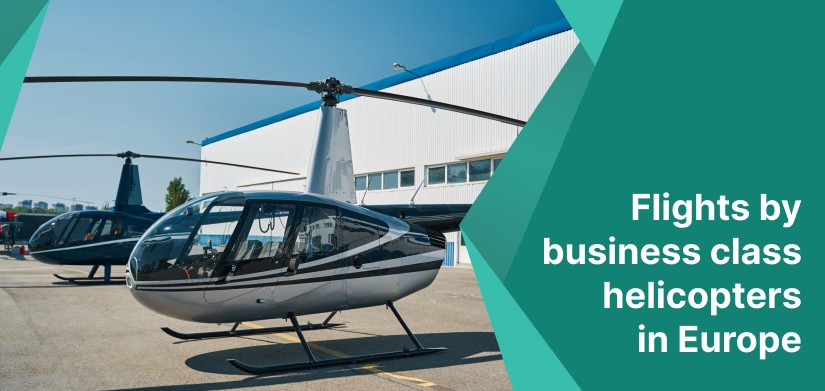
Send the departure point, destination, date and number of passengers, and the manager will reply with a single-engine and a twin-engine option:
When a helicopter is the right choice
Helicopters pay off over short distances where roads are slow or the destination has no runway. Our clients book them most often for these trips:
Nice airport to Monaco, Cannes or Saint-Tropez, often straight after a jet lands. In July and August the coast road to Saint-Tropez can take more than two hours.
Courchevel, Megève, Verbier, Gstaad, Zermatt, Lech and St. Moritz from Geneva, Chambéry, Sion, Zurich or Innsbruck, usually in 15 to 50 minutes.
Capri from Naples, Porto Cervo from Olbia, Mykonos from Athens, Lake Como from Milan Linate, and yachts that carry an approved helideck.
Visits to two or three plants, building sites or branches in one day, or a meeting outside a city where the nearest airport is an hour's drive away.
The Cannes Film Festival in May, the Monaco Grand Prix, horse racing and polo, weddings at country estates where the venue has a suitable field.
Flights over the Alps, the Riviera or a city, and aerial photography with an operator approved for such work.
Helicopter rental price per hour
The price is built on flight time multiplied by the hourly rate of the model. The rate covers the helicopter, the pilot and fuel. These are typical rates for the helicopters most often chartered in Europe:
| Model | Cruise speed | Range | Price per hour |
|---|---|---|---|
| Airbus H125single engine, 5 passengers | 245 km/h | 630 km | EUR 2,500 - 3,200 |
| Airbus H130single engine, 6 passengers | 235 km/h | 600 km | EUR 2,800 - 3,500 |
| Airbus H135twin engine, 5-6 passengers | 255 km/h | 630 km | EUR 3,800 - 4,500 |
| Leonardo AW109twin engine, 6 passengers | 280 km/h | 830 km | EUR 4,200 - 5,000 |
| Airbus H145twin engine, 7 passengers | 240 km/h | 650 km | EUR 4,500 - 5,500 |
| Bell 429twin engine, 6-7 passengers | 285 km/h | 760 km | EUR 4,500 - 5,500 |
| Leonardo AW169twin engine, 8 passengers | 265 km/h | 780 km | EUR 5,500 - 7,000 |
| Leonardo AW139twin engine, 8 passengers | 305 km/h | over 1,000 km | EUR 6,500 - 8,500 |
Passenger numbers are for VIP cabins; range is the maximum on full tanks and drops with a full cabin and luggage. Rates in Switzerland and Austria sit at the top of each range or above it. For two or three people on a short sightseeing hop, small helicopters such as the Robinson R44 or R66 cost noticeably less per hour.
What is added to the hourly rate
- Minimum flight time. Many operators bill at least 30 minutes per flight, so a 10-minute hop and a 25-minute one often cost the same. Fixed tariffs on busy routes such as Nice - Monaco are the exception.
- Positioning. If the helicopter is not based where you take off, its flight from base and back is billed too. Choosing the nearest helicopter is the main way to cut the price.
- Landing and handling. Airports, heliports and private pads charge their own fees, from a modest sum at a regional airfield to much more at Monaco or London Heliport.
- Waiting. If the helicopter waits for your return, the operator charges for the crew's time, and for a hotel if they stay overnight away from base.
- Taxes. VAT applies to domestic flights in many countries. In Italy the passenger tax on private flights is EUR 10 per person on legs up to 100 km and EUR 100 on longer legs. Every tax is listed in the quote.
Transfer prices on popular routes
Prices are one way for the whole helicopter, not per seat, with the minimum billed time, landing and handling included. They apply when a helicopter is based in the departure area and exclude VAT and passenger taxes. Flight times are for a single-engine helicopter; a twin such as the AW109 is a little faster.
French Riviera
Nice Côte d'Azur Airport has its own helicopter area, so the change from a jet to a helicopter takes minutes. Destinations along the coast are covered on the French Riviera page.
Alps
| Route | By road | Single engineup to 5 | Twin engineup to 6 |
|---|---|---|---|
| Geneva - Megève0:20 h | about 1:15 h | EUR 2,000 | EUR 2,700 |
| Chambéry - Courchevel0:25 h | about 1:30 h | EUR 2,700 | EUR 3,600 |
| Sion - Zermatt0:15 h | car and train, about 1:30 h | EUR 1,700 | EUR 2,300 |
| Geneva - Courchevel0:35 h | about 2:30 h | EUR 3,100 | EUR 4,200 |
| Geneva - Val d'Isère0:40 h | about 3 h | EUR 3,500 | EUR 4,700 |
| Innsbruck - Kitzbühel0:30 h | about 1:15 h | EUR 2,800 | EUR 3,800 |
| Geneva - Verbier0:30 h | about 2 h | EUR 3,000 | EUR 4,000 |
| Geneva - Gstaad0:35 h | about 2 h | EUR 3,300 | EUR 4,400 |
| Innsbruck - Lech0:35 h | about 1:35 h | EUR 3,300 | EUR 4,400 |
| Zurich - St. Moritz0:50 h | about 2:45 h | EUR 5,300 | EUR 7,000 |
Italy and the Greek islands
Athens - Mykonos crosses open sea, so operators fly it with twin-engine helicopters only. If your route is not listed, send it to us: the offer will show the flight time, the model and the full price.
Jet and helicopter in one trip
Many resorts have no runway for jets. In that case one manager books the private jet charter and the helicopter, and the helicopter pilot is told if the jet lands early or late. Three typical combinations:
Jet prices are for the whole aircraft one way; handling and passenger taxes are added. Other jet routes are listed on the prices page.
Hiring a helicopter for a day or a sightseeing flight
A helicopter can also stay with you for several hours or a whole day: a tour of three building sites, a programme of meetings in different towns, guests flown in to a wedding in rotations, or a day on the lakes with lunch at a hotel. The operator bills the flight hours at the model's rate plus the crew's waiting time on the ground, and some set a daily minimum of flight time. If the helicopter stays overnight away from base, the crew's hotel is added.
Single-engine or twin-engine helicopter
Most offers include both types, because the choice depends on the route, the time of day and the budget.
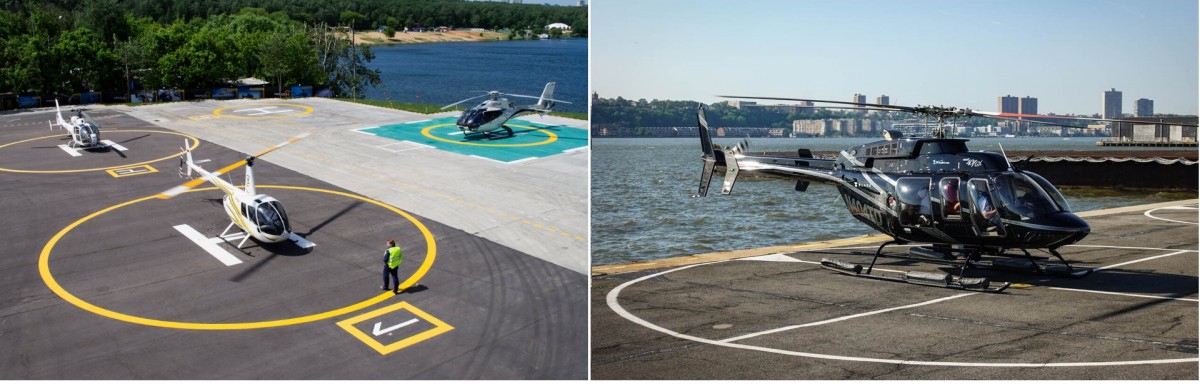
A single turbine makes the helicopter lighter and cheaper to fly, by about a third compared with a twin of similar size. Under European rules for commercial passenger flights, single-engine helicopters fly by day, in sight of the ground and in reasonable visibility, and stay clear of areas where they could not make a safe forced landing, such as dense city centres. Within these limits they are the usual choice for short transfers and mountain flights; the Airbus H125 is valued in the Alps for its performance at altitude.
- Airbus H125 (formerly AS350 Ecureuil)
- Airbus H130 (EC130)
- Airbus H120 Colibri (EC120)
- Bell 407
- Robinson R66
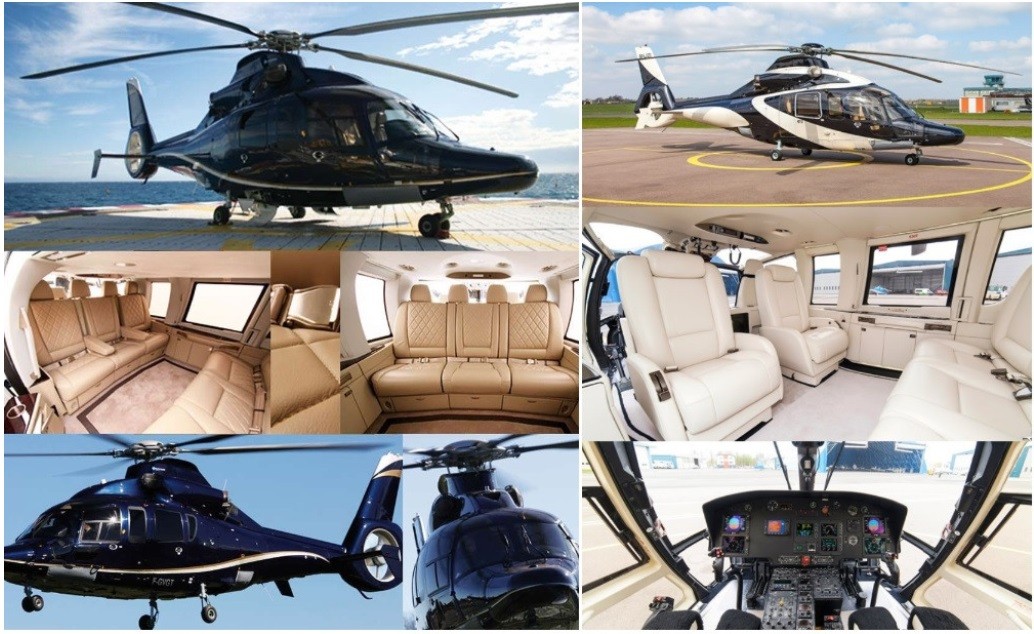
With two turbines the helicopter can continue flying if one fails. That is why operators use twins for night flights, over open sea and over large cities. Twins are usually faster, roomier and carry more luggage. Some, such as the AW109, H145, S-76 and AW139, are certified for instrument flight and can fly through cloud between airports with instrument approaches, although a heliport or a private site still needs visual conditions for landing.
- Airbus H135 and H145
- Airbus H155 (EC155) and AS365 Dauphin
- Leonardo AW109
- Bell 429
- Sikorsky S-76
- Leonardo AW169 and AW139
Where a helicopter can land
A helicopter takes off and lands at airports, heliports, mountain altiports and, with permission, private sites. These are the landing points our clients use most often in Europe:
| Place | Landing point | Good to know |
|---|---|---|
| London | London Heliport, Battersea (EGLW) | On the south bank of the Thames; flights in and out follow the river. |
| Paris | Issy-les-Moulineaux heliport (LFPI) | On the south-western edge of the city; movements are capped, so availability is checked for each flight. |
| Monaco | Monaco Heliport, Fontvieille (LNMC) | 7 minutes from Nice airport; flights in daylight. |
| Saint-Tropez | La Môle airport (LFTZ) and Grimaud heliport | Helicopter traffic around the gulf is regulated and summer demand is high, so book early. |
| Courchevel | Courchevel altiport (LFLJ) | At 2,008 m; most winter arrivals come by helicopter from Geneva, Chambéry or Lyon. |
| Megève | Megève altiport (LFHM) | About 20 minutes from Geneva. |
| Zermatt | Zermatt heliport (LSEZ) | The village is closed to ordinary cars; electric taxis run from the heliport. |
| St. Moritz | Samedan airport (LSZS) | At 1,707 m, about 5 km from St. Moritz, with customs. |
| Gstaad | Saanen airfield (LSGK) | Also used by light jets and turboprops. |
| Milan | Linate (LIML) and Bresso (LIMB) | At Linate the jet and the helicopter use the same business aviation terminal. |
| Rome | Urbe airport (LIRU) | North of the centre; day flights under visual rules only. |
| Capri | Damecuta heliport, Anacapri | Open by day only; a taxi takes you on to Capri town. |
For flights from Geneva, Zurich, Frankfurt or Vienna the helicopter uses the airport itself, usually from the business aviation side, so there is no separate heliport to drive to.
Private sites, hotels and yachts
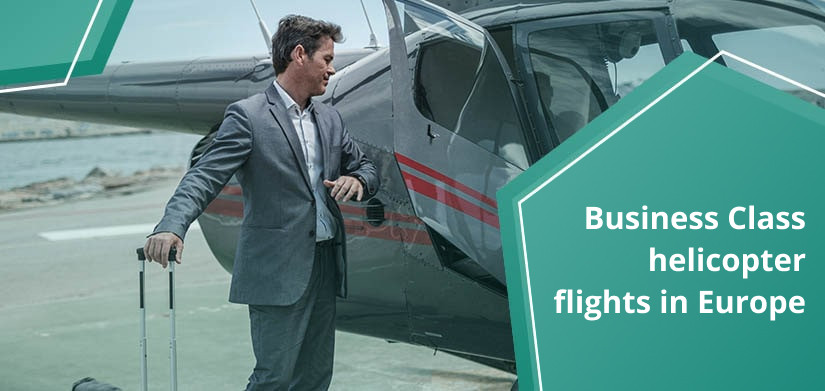
Landing at a villa, a hotel or an event venue is possible in most European countries if the site is suitable and the owner agrees. Each country has its own procedure: in some the operator only notifies the authorities, in others a permit from the local authority is needed. We handle this with the operator, which usually takes a few days.
- Space. The site must be flat, firm and clear of obstacles, roughly twice the overall length of the helicopter with rotors turning: about 26 m for an H125, more for a twin. The approach and departure path matters as much as the area itself, so trees, power lines and masts nearby can rule a site out.
- Who decides. The pilot and the operator assess the site from its coordinates and photographs of the area and its surroundings. They also need the written consent of the owner.
- Daylight. Private sites are used by day; at night only lit and approved helipads are used.
- Yachts. A helicopter lands on a yacht only if the helideck is certified for the model and the operator approves it. Otherwise guests are flown to the nearest heliport and continue by tender.
Helicopter transfers to ski resorts
In winter the helicopter turns the slowest part of the journey into a short flight. The jet lands in Geneva, Chambéry, Sion, Zurich, Innsbruck or Venice, and the helicopter covers the mountain roads in 15 to 50 minutes. For Courchevel, Megève and Méribel it lands at the resort altiports, for Zermatt at the village heliport and for Val d'Isère at a helipad at the entrance of the resort.
Mountain flights are flown by sight, and fog, snowfall, low cloud or strong wind can delay them. A car with a driver is booked as a fallback for each transfer.
Between Christmas and the first week of January and during the February school holidays, helicopters and landing slots at the altiports are taken weeks ahead.
In France leisure drop-offs on mountain slopes are forbidden, so heli-skiing is not offered there. Switzerland and Italy allow it at designated sites, with regional exceptions.
Luggage: how much fits in a helicopter
Helicopter luggage holds are far smaller than those of a jet, and every bag counts against the same weight limit as the passengers and the fuel. Plan on one soft bag of 10-15 kg per person. Hard suitcases, golf bags, fishing rods and other bulky items must be declared in the request; for a lot of luggage we suggest a larger model or a car for the bags.
Skis and snowboards
On single-engine models such as the H125 and Bell 407, many Alpine operators fit an external ski basket on the side of the fuselage. Skis and boards ride there, and the holds stay free for bags and boots.
Twins such as the H135, H145, Bell 429 and AW139 carry skis and boards in their bags in the rear hold. Length is the limit here, so give us the length of the longest pair along with the number of skis and boards.
Summer trips
A soft bag squeezes into the shaped corners of a hold where a hard case will not go. On yacht trips it is also easier to stow on board.
A golf bag in a travel cover is long and rigid and takes up most of a small hold, so list each set in the request. In the larger twins it travels with the rest of the luggage.
Cool boxes, parasols and beach bags count towards the weight like any other bag. For a day on Capri or at Porto Cervo, a small bag per person is usually enough.
A folded buggy fits in the hold of most models. A child seat or a travel cot takes the space of a suitcase, so mention it in the request.
Luggage space by model
The figures show the volume of the luggage holds, and the bar compares it with the AW139. Volumes vary with the version and the interior, and the weight allowed in the holds depends on the passengers and fuel on the day, so the operator confirms the load for each flight.
Two suitcases in the hold and soft bags in the cabin. Alpine operators add an external ski basket.
Four medium soft bags, or two hard cases and small bags. Fast, but tight for a full cabin with skis.
Two suitcases and a few soft bags spread over three holds. Ski baskets on request.
Five soft bags of up to 15 kg, or three medium suitcases.
A rear hold behind clamshell doors: one medium suitcase per passenger with a full cabin.
Rear clamshell doors open onto room for three or four medium suitcases, or for skis and golf bags.
A large aft hold: three or four medium suitcases plus hand luggage, or five or six soft bags.
The largest hold of the group, loaded from outside: usually room for a suitcase per passenger plus ski or golf bags.
Weather, night flights and changes
Most private helicopter flights are flown under visual flight rules, and the pilot decides whether it is safe to take off. If fog, low cloud, storms or strong wind prevent the flight, we offer another time or the ground transfer prepared in advance, and for islands a boat. The financial terms of a weather cancellation depend on the operator and are written in the offer and the contract.
On board: passengers, children and documents
- Weight. The operator asks for the approximate weight of each passenger and of the luggage, because it determines the load and seating plan. With a full cabin, fuel or luggage may have to be reduced.
- Children. Children of any age can fly. Infants and child seats follow the operator's rules, and everyone on board wears a headset, which also protects children's ears.
- Boarding. Arrive 15-20 minutes before departure. You walk to and from the helicopter only when the pilot or ground staff signal, and in most cases the rotors are stopped.
- Documents. Within the Schengen area, which includes Switzerland, an EU citizen needs an identity card or passport; Monaco is reached through France without border checks. A flight to or from the United Kingdom crosses the Schengen border, so the helicopter lands at an airport with passport control on the continental side, and visitors to the UK need a passport and, unless they need a visa, an electronic travel authorisation (ETA); this also applies to EU citizens.
Patient transfers by helicopter or by aircraft with a medical team are arranged separately; see medical aviation.
How to book a helicopter flight

- RequestSend the departure point and destination, the date and time, the number of passengers with approximate weights, and the luggage.
- OfferYou receive an offer with the model, the operator's name, the flight time and the price with taxes, usually with a single-engine and a twin-engine option.
- Landing siteFor a villa, hotel or event venue, send the coordinates, photographs of the site and the owner's consent. The operator checks the site and handles the notifications.
- Contract and paymentYou sign the contract remotely and pay; the flight is then confirmed.
- Before the flightYou receive the pilot's name, the meeting point and the time. If the weather is uncertain, the manager warns you in advance and keeps the fallback ready.
You can pay by bank transfer or card, and in cryptocurrency, mainly USDT and USDC; the options are on the payment page, and cancellation rules are set in the contract and in our terms and conditions. For a same-day flight, call +357 96407410, write on WhatsApp to +49 157 33565927 or leave your number:
Questions about helicopter rental
-
- How much does it cost to rent a helicopter for an hour?
-
An hour in a single-engine Airbus H125 costs EUR 2,500 - 3,200, in a twin-engine AW109 EUR 4,200 - 5,000 and in an AW139 up to EUR 8,500. Positioning, landing fees and taxes are added, so ask for a quote with your exact route.
-
- What is the cheapest helicopter transfer?
-
Nice - Monaco costs from EUR 1,200 for a whole single-engine helicopter with up to five passengers, and the flight takes about 7 minutes.
-
- Why does a 10-minute flight cost almost as much as a 30-minute one?
-
Many operators bill a minimum flight time, often 30 minutes, and the flight from the helicopter's base to your departure point is also charged. That is why we look for a helicopter based nearby.
-
- Can I rent a helicopter for a whole day?
-
Yes. You pay for the hours actually flown plus the crew's waiting time, and some operators set a daily minimum of flight time. Send us the programme of the day and we will price it.
-
- Can a helicopter land in my garden or at a hotel?
-
Usually yes, if the area is flat, clear of obstacles and the owner agrees in writing. Send the coordinates and photographs, and the operator confirms the site within a few days. Such sites are used in daylight only.
-
- Can I fly by helicopter to a yacht?
-
Only if the yacht has a helideck certified for the helicopter type and the operator approves it. Otherwise you land at the nearest heliport and the yacht's tender picks you up.
-
- How far can a helicopter fly?
-
Light helicopters cover 600-650 km on full tanks, an AW139 over 1,000 km, but with passengers and reserves the practical leg is shorter. Over about 300 km a turboprop or light jet is usually faster and cheaper.
-
- Do helicopters fly at night and in bad weather?
-
At night only twin-engine helicopters fly, and only to lit, approved helipads and airports. In fog, low cloud or strong wind the pilot postpones the flight, and the ground transfer arranged in advance takes over.
-
- Will skis, golf bags or suitcases fit in a helicopter?
-
Skis go in an external carrier or the luggage bay, depending on the model. Golf bags and hard suitcases take up most of a small bay, so list them in the request and we will choose a larger helicopter or send the bags by car.
-
- Do I need a passport for a helicopter flight to Monaco or Switzerland?
-
For EU citizens an identity card is enough: Switzerland is in the Schengen area, and Monaco is reached through France without border checks. Travellers from outside the EU need the document they normally use to enter the Schengen area.
-
- Can the helicopter wait for the jet if it lands late?
-
Yes, when we book both legs the helicopter pilot receives the jet's updated arrival time. A short delay is normally absorbed; a long one may be charged as waiting time, and at dusk the flight can only go ahead with a twin-engine helicopter to a site approved for night use.
-
- How quickly can a helicopter be arranged?
-
Between airports and heliports, often on the same day if a helicopter is based nearby. A landing at a private site needs a few days for the checks, and for the Christmas and February holidays or the Monaco Grand Prix book several weeks ahead.
The aviation expert will answer all your questions about business aviation and private flights. We will help you to compare and choose the best business jet for your flight.