
Adam A500
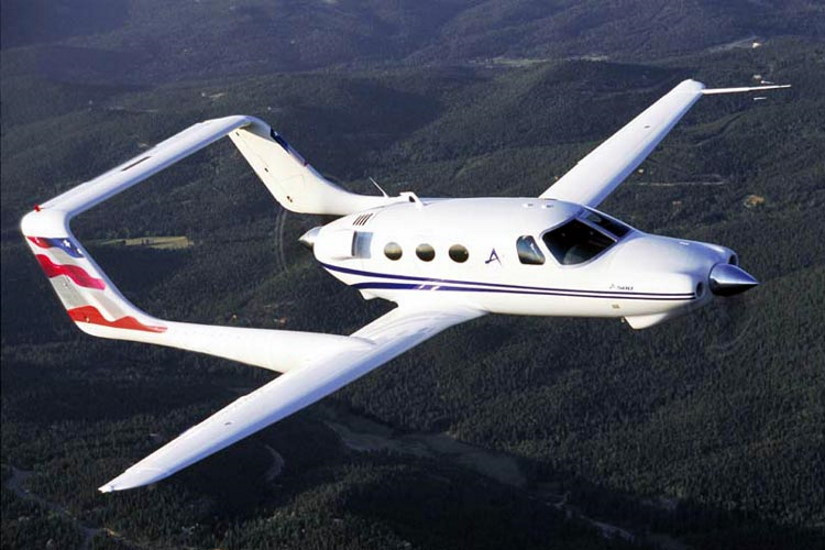
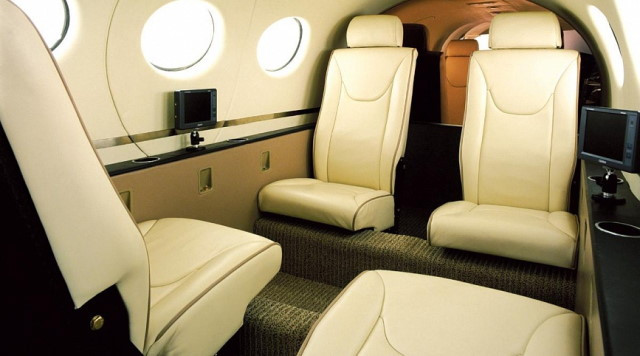
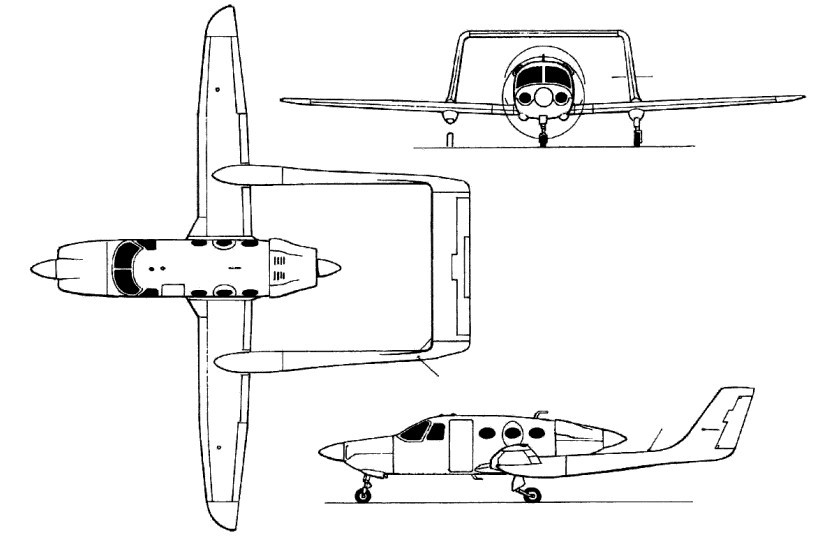
The Adam A500 is a six-seat aircraft with two Continental piston engines of 350 hp each. Despite the AdamJet name used by its maker, it is not a jet: both engines sit on the fuselage centreline, one pulling a propeller at the nose and one pushing a propeller at the tail, and two booms carry the tail surfaces. The fuselage is carbon composite and the cabin is pressurised, which piston aircraft of this size rarely offer.
Adam Aircraft went bankrupt after delivering seven aircraft, and the later owners of the design did not restart production. A charter offer for this exact type is therefore very rare. For a trip such as Geneva - Cannes or Munich - Prague we normally find another twin with the same number of seats.
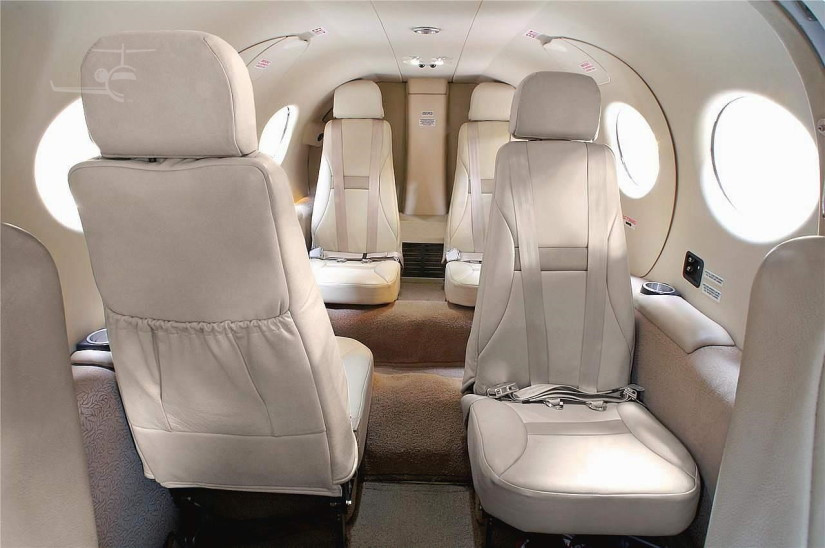
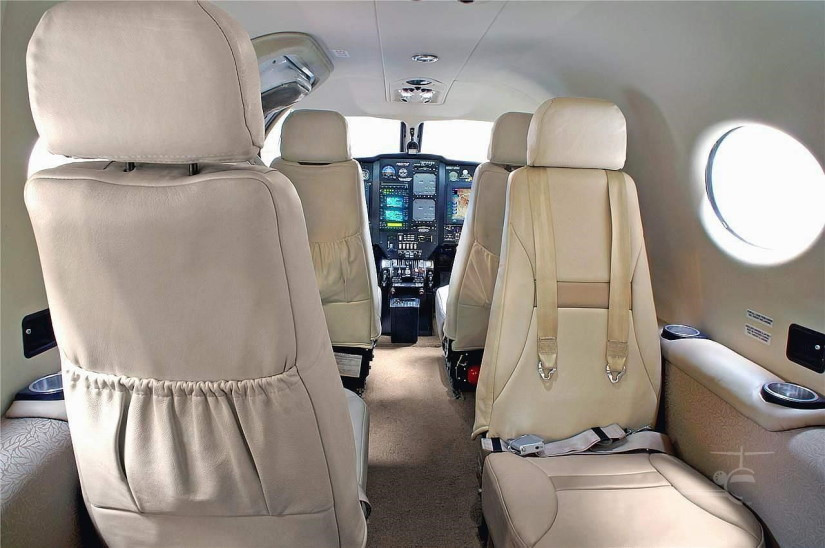
Cabin with pressurisation
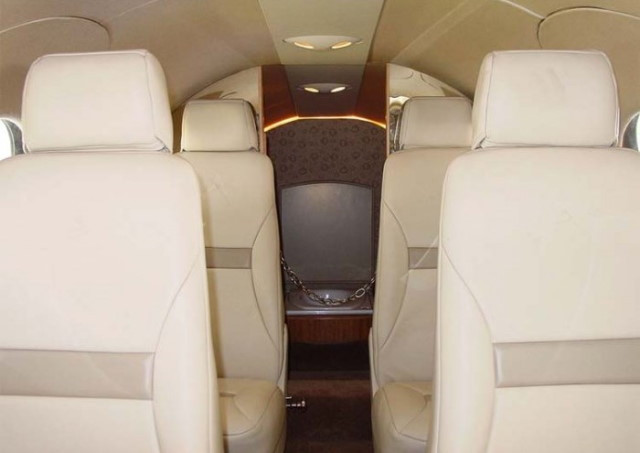
According to catalogue data the cabin is about 4.10 m long, 1.30 m high and 1.34 m wide. You sit comfortably but cannot stand. The main difference between the A500 and a Seneca or a Navajo is pressure: the aircraft can climb higher, above part of the cloud and turbulence, without oxygen masks for the passengers.
Toilet, galley and Wi-Fi depend on the individual aircraft, and with so few built there is no typical layout. Plan on drinks you bring yourself and legs of up to about two hours.
| Cabin | |
|---|---|
| Cabin height | about 1.30 m |
| Cabin width | about 1.34 m |
| Cabin length | about 4.10 m |
| Seats | 5 passengers and the pilot |
| Pressurisation | yes |
| Toilet | depends on the aircraft |
| Wi-Fi | depends on the aircraft |
Payload: fuel against passengers
These figures show where it gets tight: with full tanks just over 120 kg are left for pilot, passengers and bags. Every flight with passengers is a trade between fuel and the number of people and cases, and with five on board the A500 takes fuel for a short leg only. Soft bags and small cases are realistic; golf bags or skis only with few passengers and after agreement with the pilot.
Performance and the maintenance problem
At 75 % power the A500 covers 1,652 km, at an economical 45 % up to 2,382 km. Both figures assume full tanks, and then only about 120 kg of load remain, so with passengers in every seat the leg is much shorter.
A500 class routes from European hubs
Twenty-nine one-way legs from all thirteen hubs, without a fuel stop. Times and prices are worked out for a piston twin of this class; in practice the leg is usually flown by the aircraft we find instead, most often a Seneca or a Navajo. Prices are for the whole aircraft with pilot, without airport fees and passenger taxes.
Up to two hours: the sensible range for this class
| Route | Distance | Flight time | Price for the whole aircraft |
|---|---|---|---|
| London Farnborough - Jersey (JER) | 251 km | 1:08 h | EUR 4,000 |
| London Farnborough - Edinburgh (EDI) | 547 km | 1:52 h | EUR 5,000 |
| Paris Le Bourget - Brussels (BRU) | 261 km | 1:09 h | EUR 4,000 |
| Paris Le Bourget - Jersey (JER) | 338 km | 1:21 h | EUR 4,500 |
| Geneva - Lugano (LUG) | 217 km | 1:03 h | EUR 4,000 |
| Geneva - Cannes (CEQ) | 306 km | 1:16 h | EUR 4,500 |
| Nice - Figari (FSC) | 285 km | 1:13 h | EUR 4,000 |
| Nice - Olbia (OLB) | 361 km | 1:24 h | EUR 4,500 |
| Zurich - Salzburg (SZG) | 336 km | 1:20 h | EUR 4,500 |
| Milan Linate - Pisa (PSA) | 215 km | 1:02 h | EUR 4,000 |
| Milan Linate - Olbia (OLB) | 506 km | 1:46 h | EUR 5,000 |
| Munich - Prague (PRG) | 265 km | 1:10 h | EUR 4,000 |
| Munich - Vienna (VIE) | 355 km | 1:23 h | EUR 4,500 |
| Frankfurt - Berlin (BER) | 431 km | 1:35 h | EUR 4,500 |
| Vienna - Budapest (BUD) | 215 km | 1:02 h | EUR 4,000 |
| Vienna - Split (SPU) | 509 km | 1:46 h | EUR 5,000 |
| Amsterdam - Luxembourg (LUX) | 315 km | 1:17 h | EUR 4,500 |
| Hamburg - Copenhagen (CPH) | 280 km | 1:12 h | EUR 4,000 |
| Madrid - Porto (OPO) | 438 km | 1:36 h | EUR 4,500 |
| Madrid - Palma (PMI) | 547 km | 1:52 h | EUR 5,000 |
| Larnaca - Tel Aviv (TLV) | 339 km | 1:21 h | EUR 4,500 |
| Larnaca - Rhodes (RHO) | 529 km | 1:49 h | EUR 5,000 |
Two to four hours: with few passengers and light bags
| Route | Distance | Flight time | Price for the whole aircraft |
|---|---|---|---|
| London Farnborough - Geneva (GVA) | 753 km | 2:23 h | EUR 5,500 |
| Paris Le Bourget - Nice (NCE) | 694 km | 2:14 h | EUR 5,000 |
| Geneva - Palma (PMI) | 792 km | 2:29 h | EUR 5,500 |
| Nice - Ibiza (IBZ) | 722 km | 2:18 h | EUR 5,500 |
| Zurich - Berlin (BER) | 650 km | 2:08 h | EUR 5,000 |
| Munich - Split (SPU) | 639 km | 2:06 h | EUR 5,000 |
| Frankfurt - Copenhagen (CPH) | 680 km | 2:12 h | EUR 5,000 |
Most rows take between one and two hours, the range where an A500 or a similar twin makes sense. Seven go beyond two hours, the longest being London - Geneva (2:23 h) and Geneva - Majorca (2:29 h); with four or five people and luggage a piston twin may need a fuel stop on these, and Nice - Ibiza (2:18 h) is a long time in a small cabin.
The calculator gives an indicative price for a small twin on your own route; we then check which aircraft is actually free.
What a flight in this class costs
The rate for a piston twin of this size starts at EUR 1,000 per flight hour for the whole aircraft with pilot and fuel. A short leg costs more than rate times time: Munich - Prague takes 1:10 h and starts at EUR 4,000, because the quote includes the operator's minimum charge and the flight from the aircraft's base.
Further away the hour gets cheaper: Frankfurt - Berlin (1:35 h) starts at EUR 4,500 and Geneva - Majorca (2:29 h) at EUR 5,500. These are prices for the class, and an offer for an A500 or for the aircraft actually available can differ.
The price is for the whole aircraft; split between passengers, Munich - Prague comes to:
How to pay less
- Ask for the class, not the type: a free Seneca or Navajo near you costs less than bringing an A500 from far away
- Fly back the same day on legs such as Vienna - Budapest or Milan - Pisa, so no pilot hotel is needed
- Keep the departure time flexible by a few hours
- Travel with fewer bags, which can save a fuel stop
Empty Legs
On the A500 itself Empty Legs practically never appear. Other small twins and turboprops have them now and then, mostly on returns from the islands or the Riviera, and they can be 30-60% cheaper than a normal charter; these figures are examples, not guaranteed. The date and route are fixed, and the leg can be cancelled if the aircraft gets a full booking.
Send the route and a date window to empty-legs@jets.flights or through the Empty Legs page, and we look for small aircraft of a similar size.
What to fly instead of an A500
- Pressurised cabin, rare for a piston aircraft
- Centreline engines, easier handling on one engine
- Composite airframe and 410 km/h cruise
- Only seven aircraft built
- No manufacturer support
- About 120 kg of payload with full tanks
- Almost never offered for charter
The realistic alternatives are piston twins that operators actually fly and pressurised turboprops:
How to request a flight
Send us the route, date, number of people and baggage. We tell you straight away whether an A500 is available, offer a twin of similar size and say whether the leg needs a stop. We always try to match what you asked for, but each case depends on the operator's availability and contract.
Questions about the Adam A500
-
- Can I charter an Adam A500?
-
In principle, if an owner holds an AOC or makes the aircraft available to an operator. With seven built and no manufacturer, such an offer is very rare. We usually propose a Seneca, a Navajo or a turboprop.
-
- How much does a flight in this class cost?
-
London Farnborough to Jersey (1:08 h) starts at EUR 4,000 and Madrid to Majorca (1:52 h) at EUR 5,000 for the whole aircraft one way, before airport fees and passenger taxes.
-
- What is included in the price?
-
The aircraft, the pilot and fuel. Airport and handling fees, passenger taxes, positioning, the pilot's hotel on a later return and de-icing are listed separately in the quote.
-
- Why does a one-hour leg cost more than the hourly rate?
-
The operator adds a minimum charge and the flight from its base. Vienna to Budapest takes 1:02 h and starts at EUR 4,000, while on Vienna to Split (1:46 h, from EUR 5,000) the gap is smaller.
-
- How can I fly for less?
-
Accept a comparable twin based near you, fly back the same day, keep the time flexible and travel light.
-
- Are there Empty Legs on the A500?
-
Practically none. On other small twins and turboprops they appear from time to time, at 30-60% below a normal charter, on the operator's fixed date and route.
-
- Is the AdamJet A500 a jet?
-
No. It has two piston engines with propellers. The manufacturer also developed a jet version, the A700, but it never entered series production before the company closed.
-
- How many passengers can fly?
-
There are five passenger seats, but with full tanks only just over 120 kg remain for people and bags. With every seat taken the aircraft can carry fuel for a short leg only.
-
- Why are the engines at the front and the back?
-
So that the aircraft does not swing to one side when one engine stops, as happens on twins with engines on the wings. The pilot holds the heading more easily, and the aircraft handles much like a single-engine one.
The aviation expert will answer all your questions about business aviation and private flights. We will help you to compare and choose the best business jet for your flight.